Loading...
Join our Facebook Group: Join: Expats in Poland
Loading...
Everything you need to know about working legally in Poland as a foreigner. From work permits and visa applications to what happens after you arrive.

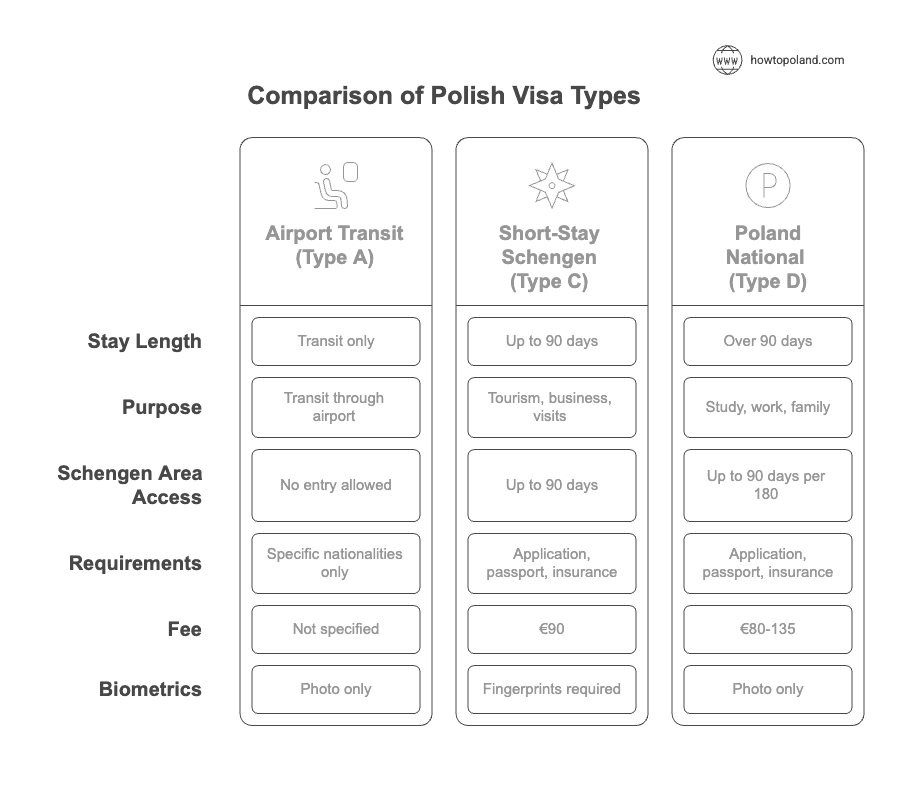
A Polish work visa is a Type D national visa that allows you to live and work in Poland for longer than 90 days. It is the standard entry document for non-EU citizens who have a job offer from a Polish employer.
The work visa is tied to a specific employer and a specific position. This means you cannot simply switch jobs on the same visa - if you change employers, you will need a new work permit and potentially a new visa or residence permit. The visa is typically issued for the duration of your work permit, up to a maximum of one year. After that, most people switch to a temporary residence permit (karta pobytu), which is more flexible.
Poland has become one of the largest issuers of work permits in the EU. In 2024 alone, Polish authorities issued over 600,000 work permits, mostly to citizens of Ukraine, Belarus, India, Nepal, and the Philippines. The system is well-established and, while bureaucratic, is straightforward once you understand the steps.
Quick summary
Type D visa → valid for up to 1 year → tied to one employer → requires a work permit first → can lead to a residence permit after arrival.
Not everyone needs a work visa to work in Poland. Your obligations depend on your nationality and current immigration status.
A citizen of any country not listed above who wants to work in Poland for more than 90 days. This includes citizens of India, the Philippines, Nepal, Bangladesh, Turkey, Vietnam, and most other non-EU countries. You will need both a work permit (obtained by your employer) and a Type D visa (obtained by you at the Polish consulate). If you don't have a job offer yet, read our guide to finding a job in Poland.
Even if you are exempt from the work permit, you may still need a visa to enter Poland. Check the Polish MFA visa checker to see if your nationality requires a visa for entry.
Before you can apply for a work visa, your employer usually needs to obtain a work permit for you. Poland has six types of work permits, labeled A through E and S. The type you need depends on your employment situation.
This is by far the most common type. It covers foreigners employed by a company registered in Poland under a standard employment contract (umowa o prace) or a civil-law contract (umowa zlecenie). Your employer applies for it at the Voivodeship Office (Urzad Wojewodzki) in the region where the company is registered. The permit is issued for a specific position and employer, for up to 3 years.
For foreigners serving on the board of directors or management board of a company, partnership, or cooperative in Poland. This applies to executives of companies with more than 25 employees. The permit is valid for up to 3 years. If you are planning to set up a company, see our business visa guide and how to start a business in Poland.
For employees of a foreign company who are posted (delegated) to work at the company's Polish branch or a related entity for more than 30 days in a 6-month period. This is common for multinational corporations moving staff between offices.
For employees of a foreign company that has no branch in Poland but is performing a temporary service in Poland (for example, a construction contract). The employer remains the foreign entity, but the work is carried out on Polish territory.
A catch-all category for posted workers not covered by types C or D. Rarely used in practice.
For seasonal work in agriculture, horticulture, and tourism sectors. Valid for up to 9 months within a calendar year. The application process is faster and the requirements are simpler than for a Type A permit. The employer applies at the local Powiat (county) labor office rather than the Voivodeship Office.
Citizens of Ukraine, Belarus, Armenia, Georgia, and Moldova can work in Poland for up to 24 months under a simplified procedure. Instead of a full work permit, the employer registers a declaration of employment (oswiadczenie o powierzeniu wykonywania pracy) at the local labor office. This is faster - it usually takes 7 working days - and free of charge. However, the worker still needs a visa to enter Poland.
This simplified procedure has been enormously popular. It is the primary mechanism through which hundreds of thousands of Ukrainians have entered the Polish labor market over the past decade. If you are self-employed or a freelancer, you may want to look at the freelance visa instead.
The EU Blue Card is a special residence and work permit for highly qualified non-EU professionals. It is not a visa itself but rather a type of temporary residence permit that combines work and residence authorization in one document. In Poland, it is formally called "zezwolenie na pobyt czasowy w celu wykonywania pracy w zawodzie wymagajacym wysokich kwalifikacji."
The Blue Card has several significant advantages over a regular work permit:
To apply for an EU Blue Card in Poland, you first enter on a Type D work visa, then apply for the Blue Card at your local Voivodeship Office (Urzad Wojewodzki) after arriving.
Need help with your application?
Get matched for free with a verified, English-speaking immigration specialist in your city.
When applying for a Polish work visa at the consulate, you will need to prepare the following documents. Requirements can vary slightly between consulates, so always check with the specific embassy handling your application.
Tip: All documents not in Polish or English typically need to be translated by a sworn translator (tlumacz przysiegly). Sworn translations in Poland cost 30-60 PLN per page. You can find certified translators at the Ministry of Justice website.
Getting a work visa for Poland involves coordination between you and your employer. Here is the full process from start to finish:
Your employer applies for a work permit (Type A in most cases) at the Voivodeship Office in the region where the company is registered. Before applying, the employer must conduct a "labor market test" - they post the job opening at the local labor office (Powiatowy Urzad Pracy) for at least 14 days to verify that no Polish or EU citizen is available for the position. Some occupations are exempt from this test. The labor office issues an opinion, and then the Voivodeship Office makes the final decision. This step takes 1-2 months on average, but can take longer in busy regions like Mazowieckie (Warsaw).
Once the work permit is issued, your employer mails or couriers the original document to you. You need the physical original for your visa application - a scanned copy is not enough. Some consulates accept a notarized copy, but it is safer to have the original.
Register on the e-Konsulat portal, fill out the visa application form, and book an appointment at the Polish consulate or embassy in your country of residence. Appointments can be hard to get in high-demand countries (India, Philippines, Nepal), so book as early as possible. You can book up to 6 months before your planned travel date.
Bring all required documents (see section above) to your appointment. You must appear in person for biometric data collection (fingerprints and photo). The consular officer may ask you questions about your employer, job duties, and plans in Poland. Be prepared to answer clearly and consistently with the information in your documents.
The consulate processes your application and may contact you for additional documents. The official processing time is up to 15 days, but in practice it takes 30-60 days depending on the consulate. Some consulates in high-volume countries can take up to 90 days.
Once approved, collect your passport with the visa sticker from the consulate (or it will be mailed to you, depending on the consulate). You can enter Poland on or after the start date printed on the visa. When you arrive, border guards may ask to see your work permit and employment contract.
Get matched for free with a verified, English-speaking specialist in your city.
Verified specialists only
We only recommend licensed adwokat and radca prawny registered with the Polish Bar
English-speaking
All partners are fluent in English and experienced with foreign clients
Free matching service
No cost to you - we connect you directly with the right specialist for your case
Immigration specialists
Our partners focus exclusively on immigration law - not generalists
Working in Poland involves several fees paid at different stages. Here is what you and your employer can expect to pay:
| Fee | Amount | Paid by |
|---|---|---|
| Work permit (Type A) | 100 PLN (up to 3 months) / 200 PLN (over 3 months) | Employer |
| Seasonal work permit (Type S) | 30 PLN | Employer |
| Employer's Declaration (oswiadczenie) | 100 PLN | Employer |
| Type D visa fee | 80 EUR | Employee |
| Visa fee (children 6-12) | 40 EUR | Employee |
| VFS/TLS service center fee | 20-30 EUR (varies by country) | Employee |
| Sworn translations | 30-60 PLN per page | Varies |
| Travel insurance | 50-200 EUR (depends on duration) | Employee |
| Apostille on documents | Varies by country (typically 20-100 USD) | Employee |
In total, expect to spend around 200-400 EUR on the visa application process as an employee, plus whatever your home country charges for apostilles and background checks. For travel insurance options, check our insurance guide. The employer's costs are relatively low (100-200 PLN for the work permit), though they may also spend money on a lawyer or HR specialist to handle the paperwork.
Some employers cover all costs, including the visa fee and travel expenses, as part of the relocation package. This is more common for highly skilled positions and EU Blue Card holders. If your employer is not offering to cover these costs, it is worth negotiating - especially for the work permit fee, which is legally the employer's responsibility.
Total processing time from start to finish depends on the type of permit and the workload at the relevant offices. Here is a realistic timeline:
Work permit (Type A): 1-3 months
The legal deadline is 30 days (or 60 days for complex cases), but in practice it takes longer in high-volume regions. Warsaw (Mazowieckie) and Krakow (Malopolskie) are typically the slowest. Smaller voivodeships like Podlaskie or Opolskie are faster.
Employer's Declaration (oswiadczenie): 7 working days
This is the simplified procedure for citizens of Ukraine, Belarus, Armenia, Georgia, and Moldova. It is processed at the local Powiat labor office and is significantly faster.
Visa application: 15-60 days
The official processing time is up to 15 calendar days, but high-volume consulates (New Delhi, Manila, Kathmandu) often take 30-60 days. Consulates in EU countries or the US tend to be faster.
Getting an appointment: varies wildly
In some countries, the hardest part is simply getting an appointment at the consulate. Wait times of 2-4 weeks for an appointment are common. In peak periods, it can be longer. Book as soon as you have your work permit.
Realistic total timeline: 2-5 months from the moment your employer starts the work permit application to the day you receive your visa. Plan accordingly and do not book flights until you have the visa in hand.
Polish law places most of the administrative burden on the employer, not the employee. If a company wants to hire a foreigner, here is what they are responsible for:
Red flag: If a potential employer asks you to pay for the work permit yourself, or asks you to arrange the work permit on your own, this is a warning sign. By Polish law, the employer is responsible for obtaining the work permit. An employer who refuses to handle this may not be legitimate or may not understand the legal process.
Landing in Poland with your work visa is just the beginning. For a broader overview, see our complete guide to moving to Poland. Here is what you need to do in your first weeks:
Polish employment law has several contract types, and which one you get matters a lot - it affects your taxes, insurance, worker protections, and even your visa status. Make sure you understand what you're signing.
| Contract | Type | Benefits | Protection |
|---|---|---|---|
| Umowa o prace | Employment contract | Full (ZUS, health, pension, vacation) | Full labor code protection |
| Umowa zlecenie | Civil-law contract (mandate) | ZUS + health, no paid vacation | Limited |
| Umowa o dzielo | Contract for specific work | None (no ZUS, no health) | None |
| B2B | Self-employment (JDG) | Self-arranged | None (you're a contractor) |
This is the gold standard and what you should aim for. It gives you full protection under the Polish Labor Code: paid vacation (20-26 days), sick leave, notice periods, overtime pay, maternity/paternity leave, and full ZUS coverage (health insurance, pension, disability). Your employer handles all tax and ZUS deductions from your salary. Work permits are most commonly issued for this contract type.
A civil-law contract that's common for part-time, temporary, or flexible work. You get ZUS and health insurance contributions, but no paid vacation, no notice period, and no labor code protections. You can be let go at any time. Some employers use zlecenie to avoid the obligations of a full employment contract - if your work looks like regular employment (fixed hours, fixed location, supervision), it should legally be umowa o prace. Work permits can be issued for zlecenie contracts.
A project-based contract with no social security contributions and no health insurance. It's meant for one-off deliverables (writing an article, designing a logo). It's rarely appropriate for ongoing work, and work permits are generally not issued for dzielo contracts. Avoid this as your primary employment arrangement.
Working as a sole trader (jednoosobowa dzialalnosc gospodarcza / JDG). Popular in IT and consulting because of lower tax rates (flat 19% or ryczalt). You invoice the company monthly instead of receiving a salary. You handle your own ZUS, taxes, and accounting. This requires a different visa/permit path - see our freelance visa guide and starting a business guide. A standard work permit does NOT cover B2B arrangements.
Your work permit is tied to one specific employer, position, and salary. Changing any of these requires a new permit. Here's how it works in practice:
If you get promoted or change roles at the same company, your employer needs to apply for a new work permit (or an amendment) that reflects the new position. You can keep working during the process as long as the application is filed before the old permit expires.
Your new employer must apply for a fresh work permit. The full process starts over: labor market test, Voivodeship Office application, waiting for approval. During this time, you cannot work for the new employer until the new permit is issued. Some people negotiate a start date that accounts for the processing time.
If you already have a temporary residence and work permit (karta pobytu), the process is slightly different. You need to apply for a change of conditions on your residence permit through the MOS system. You can start working for the new employer as soon as the application is filed (with the new employer's work permit or declaration already in hand).
If you quit or are fired, your work permit becomes invalid. Your visa or residence permit stays valid until its expiry date, so you can remain in Poland legally - but you can't work. If you have a karta pobytu, you must notify the Voivodeship Office within 15 business days of losing your job. You then have a reasonable period to find a new employer (the law doesn't specify an exact timeframe, but 30-60 days is the general expectation before your permit may be revoked).
Blue Card holders have more flexibility. During the first 12 months, changing employers requires approval from the Voivodeship Office. After 12 months, you only need to notify the office of the change - no approval needed. This is one of the main advantages of the Blue Card over a standard work permit.
If you're on an umowa o prace (employment contract), Polish labor law gives you strong protections - often stronger than what you might be used to from the US, India, or the Middle East.
20 days per year if you have less than 10 years of work experience (including university years - a master's degree counts as 8 years), or 26 daysif you have 10+ years. This is paid leave, and your employer can't deny it - they can negotiate timing, but you're legally entitled to at least one uninterrupted 14-day block per year. Unused vacation carries over to the next year and must be used by September 30.
If you're sick, a doctor issues an electronic sick leave certificate (e-ZLA). For the first 33 days per year (14 days if you're over 50), your employer pays 80% of your salary. After that, ZUS takes over and pays 80% as sickness benefit, for up to 182 days. You don't need to use vacation days when you're ill.
Standard working time is 8 hours per day, 40 hours per week(Monday to Friday). Overtime requires extra pay: 150% for weekday overtime and 200% for Sundays, holidays, and night shifts. Your employer can't force regular overtime - it's only for exceptional situations. Maximum overtime: 150 hours per year (unless your contract says otherwise, up to 416 hours).
Your employer can't fire you on the spot (except for gross misconduct). Notice periods depend on how long you've worked there:
During the notice period, you keep your full salary and benefits. You also get paid time off to look for a new job (2-3 days depending on your notice period).
Maternity leave: 20 weeks at 100% salary (for a single child). Paternity leave: 2 weeks at 100% salary. After maternity leave, either parent can take up to 41 weeks of parental leave at 70% salary (or 81.5% if declared upfront). These rights apply equally to foreign workers on umowa o prace. Use our parental allowance calculator to estimate your benefits.
Poland has 13 public holidaysper year. If a holiday falls on a Saturday, you get a replacement day off on another workday. Major holidays: New Year's Day, Easter (2 days), May 1, May 3, Corpus Christi, August 15, November 1, November 11, Christmas (2 days).
Understanding Polish salary levels helps you negotiate and avoid being underpaid. All figures below are gross monthly (before tax and ZUS deductions). Use our gross-to-net calculatorto see what you'll actually take home.
| Industry | Typical gross salary |
|---|---|
| IT / Software development | 12,000-25,000 PLN |
| Finance / Banking | 8,000-15,000 PLN |
| Shared services / BPO | 6,000-10,000 PLN |
| Engineering / Manufacturing | 7,000-12,000 PLN |
| Healthcare | 6,000-15,000 PLN |
| Construction / Logistics | 5,000-8,000 PLN |
| Hospitality / Gastronomy | 4,666-6,000 PLN |
| Agriculture (seasonal) | 4,666-5,500 PLN |
Warsaw salaries tend to be 20-30% higher than in smaller cities, but the cost of living is also higher. Krakow, Wroclaw, and Gdansk are slightly cheaper with salaries 10-15% below Warsaw. Taxes in Poland are moderate: most employees pay an effective rate of 25-35% (income tax + ZUS combined). See our tax rates guide for details.
Working remotely for a foreign company while living in Poland is increasingly common, especially in IT. But the legal situation isn't straightforward.
Remote work (praca zdalna) was formally regulated in the Polish Labor Code in 2023. If you have an umowa o prace with a Polish company, you can work from home - either full-time or in a hybrid arrangement. Your employer must cover the costs of remote work (electricity, internet) and provide equipment or an equivalent allowance. Your work permit and visa are unaffected - you're still employed by a Polish entity.
This is where it gets complicated. A standard Polish work visa requires employment by a Polish employer. If you work remotely for a company in the US, UK, Germany, or elsewhere, you generally have three legal options:
What you can'tdo: live in Poland on a tourist visa or visa-free stay and work remotely for a foreign company. If you're a tax resident in Poland (living here 183+ days per year), you owe Polish taxes on your worldwide income regardless of where your employer is based. Working without proper legal status means no health insurance through NFZ, no ZUS contributions, and potential tax problems.
Practical advice:If you're a remote worker planning to move to Poland, the B2B or EOR route is what most people use. Talk to a Polish tax advisor before making the move - the tax implications depend on your nationality, the country of your employer, and applicable tax treaties. Getting this wrong can be expensive.
A work visa gets you into Poland, but it is not meant to be a long-term solution. Most workers switch to a temporary residence and work permit (karta pobytu) after arriving. This is both more practical and offers more rights.
You can apply for a temporary residence permit at any point during your legal stay in Poland. The key rule is: you must submit the application before your current visa expires. As long as you submit the application on time, you can legally stay and work in Poland while it is being processed - even if processing takes months. Your passport will receive a stamp confirming the application.
We recommend applying 2-3 months before your visa expires. Since April 2026, the application is submitted online through the MOS system (mos.cudzoziemcy.gov.pl) - paper applications are no longer accepted. After submitting electronically, you will be summoned to the Voivodeship Office in person for document verification and fingerprints. Processing times vary, but expect 2-6 months in most regions, and up to 12 months in Warsaw.
For a detailed guide, see our residence permit (karta pobytu) page.
Having helped thousands of foreigners navigate the Polish work visa process, here are the most common mistakes people make:
Work visa applications get refused more often than people expect. The most common reasons:
If your visa is refused, you can appeal within 7 days. The appeal goes to the Ministry of Foreign Affairs. Having all documents properly prepared and professionally translated significantly reduces the risk of rejection.
Yes. In almost all cases, your employer must first obtain a work permit (or register an oswiadczenie for simplified-procedure countries) before you can apply for the visa. The consulate will not process your visa application without a valid work permit or declaration.
Not without getting a new work permit. Work permits and visas are tied to a specific employer, position, and salary. If you want to change jobs, your new employer must apply for a new work permit, and you may need to apply for a new visa or residence permit. The exception is EU Blue Card holders after 12 months - they only need to notify the authorities of the change.
Yes. Your spouse and children under 18 can apply for a family reunion visa (Type D) to join you in Poland. They can also apply for their own temporary residence permits after arriving. Your spouse will be able to work in Poland without a separate work permit once they have a residence permit based on family reunification. See our family reunion visa guide for details.
If you lose your job, your work permit becomes invalid, but your visa remains valid until its expiry date. You can legally stay in Poland but cannot work. You have two options: find a new employer who will apply for a new work permit, or leave Poland before your visa expires. If you already have a temporary residence permit (karta pobytu) for work, you have 30 days to notify the Voivodeship Office and find a new employer before the permit can be revoked.
You can apply for a permanent residence permit after 5 years of continuous legal residence in Poland, provided you have a stable income, health insurance, and knowledge of Polish (B1 level certificate). EU Blue Card holders benefit from a faster track - they can apply for an EU long-term residence permit after just 2 years. Permanent residence gives you the right to live and work in Poland indefinitely without needing further permits.
Your salary must meet or exceed the Polish minimum wage, which is 4,666 PLN gross per month in 2026. For an EU Blue Card, the salary threshold is higher - at least 1.5x the average national salary (approximately 9,300-9,600 PLN gross per month). The salary stated in your work permit must match the salary in your employment contract.
A Polish work visa is specifically for employment by a Polish employer. If you want to work remotely for a foreign company while living in Poland, the legal situation is different. You may need to register as self-employed (JDG) or your foreign employer may need to set up a Polish entity. Some people use a Type C or D visa for "other purposes" combined with a contractor arrangement, but this is a gray area. Consult an immigration specialist for your specific situation.
No. There is no Polish language requirement for a work visa or work permit. Many foreigners work in Poland without speaking Polish, especially in IT, shared service centers, and international companies. However, learning basic Polish will make daily life significantly easier and is required (B1 level) if you later want to apply for permanent residence or citizenship.