Loading...
Join our Facebook Group: Join: Expats in Poland
Loading...
Poland doesn't have a dedicated 'freelance visa' in its immigration law. What it does have is a clear legal path for foreigners to register a sole proprietorship (JDG), work as independent contractors, and obtain residence permits for self-employment. This guide explains the entire process - from choosing the right visa type and registering your business to handling taxes, ZUS contributions, and the practical realities of freelancing in Poland.
If you search for "freelance visa Poland," you'll find dozens of articles describing a specific visa category for freelancers. The reality is more nuanced. Polish immigration law doesn't define a separate visa class called a "freelance visa." What exists is a set of visa and permit categories that allow self-employment, and freelancing falls under that umbrella.
The legal basis for working as a freelancer in Poland is the Act on Foreigners (Ustawa o cudzoziemcach) and the Freedom of Economic Activity Act (Prawo przedsiebiorcow). Together, these laws allow foreigners to register a sole proprietorship - called jednoosobowa dzialalnosc gospodarcza (JDG) - and obtain a residence permit for the purpose of conducting business activity.
In practice, "freelancing" in Poland means registering a JDG, invoicing your clients as a business, paying your own taxes and social insurance (ZUS), and holding a visa or residence permit that authorizes self-employment. Whether you're a software developer working on B2B contracts, a graphic designer with international clients, or a consultant serving Polish companies, the legal framework is the same.
EU/EEA citizens have it straightforward - they can register a JDG and start working immediately without any visa or permit. Non-EU citizens need to first secure a legal basis for their stay (a national visa or residence permit) and then register their business.
The right document depends on your nationality and how long you plan to stay. Here are the main options:
You don't need any visa or work permit. You have the right to live and work in Poland under EU freedom of movement. Simply register your residence at the local voivodeship office if you plan to stay longer than 3 months, register your JDG, and start working. The residence registration is a formality, not a permit - it can't be denied.
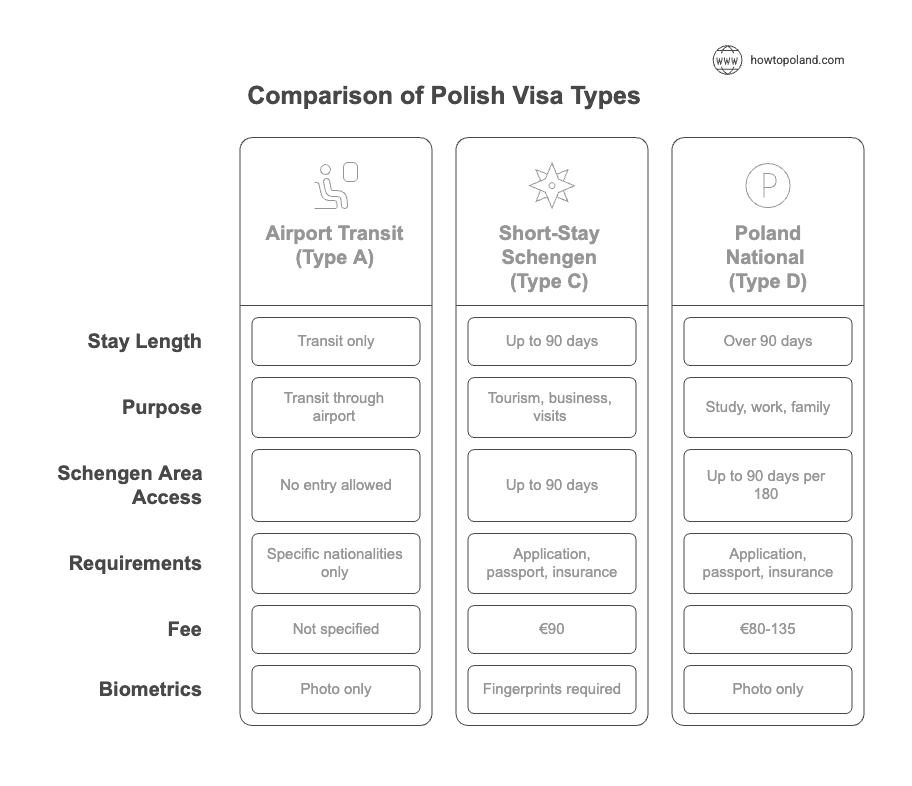
A national visa (type D) for business purposes is your entry ticket. You apply at the Polish consulate in your home country before traveling. This visa is valid for up to 1 year and allows stays of up to 365 days. The purpose code you need is "09" - conducting business activity (prowadzenie dzialalnosci gospodarczej).
The type D visa isn't renewable from within Poland. The standard strategy is: get the type D visa, enter Poland, register your JDG, start your business activity, and then apply for a temporary residence permit (which is renewable and issued for up to 3 years). Note: the Poland Business Harbour (PBH) program, which previously fast-tracked this process for IT workers, has been suspended since January 2024.
The temporary residence permit for the purpose of conducting business activity (zezwolenie na pobyt czasowy w celu prowadzenia dzialalnosci gospodarczej) is the main long-term option. It is issued for up to 3 years and is renewable. You apply at the voivodeship office (Urzad Wojewodzki) in the city where you live.
This is the permit that most people informally call the "freelance visa." It authorizes you to live in Poland and conduct business through your registered JDG. It doesn't authorize employment - if you also want to work as an employee, you need a separate permit or an additional annotation on your residence card.
The residence permit for conducting business activity has stricter requirements than a simple work permit. The voivodeship office evaluates whether your business is genuinely beneficial to Poland. This is the part where many applications get complicated.
The law (Article 142 of the Act on Foreigners) states that a residence permit for business activity can be granted if your business meets at least one of the following conditions:
Your business generated income in the previous tax year of at least 12 times the average monthly salary in Poland (approximately 100,000 PLN annually as of 2026), or
You employ at least 2 Polish citizens or foreigners who have the right to work, or
You can demonstrate that the business has the means to meet the above conditions in the future, or
Your business activity is beneficial to the economic interests of Poland, beneficial to the region, or contributes to innovation and job creation.
For new businesses and first-time applicants, conditions 3 and 4 are the most commonly used. This is where a solid business plan comes in - you need to convince the voivodeship office that your freelance activity will succeed and benefit Poland. Showing existing contracts, a portfolio of clients, or letters of intent from Polish companies significantly strengthens your case.
Officially 1-2 months, but in practice 3-6 months depending on the voivodeship. Warsaw and Masovian voivodeship are the slowest. Since April 2026, applications are submitted electronically through the MOS system- paper applications are no longer accepted. Once submitted, you'll be summoned in person for document verification and fingerprints. Your stay is legal while waiting for the decision, and you can continue business activity during this period.
Need help with your application?
Get matched for free with a verified, English-speaking immigration specialist in your city.
A sole proprietorship (jednoosobowa dzialalnosc gospodarcza, abbreviated JDG) is the standard business form for freelancers in Poland. It is simple to set up, has minimal paperwork, and gives you full control. You invoice clients as a business, not as an individual, which is the legal requirement for providing services commercially in Poland.
EU/EEA citizens can register freely. Non-EU citizens can register a JDG if they hold a valid residence permit, a temporary residence permit, a long-term EU resident status, a refugee status, or certain other legal statuses specified in Article 4 of the Prawo przedsiebiorcow act. If you are on a type D national visa, your right to register a JDG depends on the specific visa type - visas issued for business activity purposes (code 09) allow it.
You need a PESEL (Polish national identification number) before you can register a business. If you have a residence permit, you should already have one. If not, apply at the local municipal office (Urzad Gminy). Processing typically takes 1-2 weeks.
This is Poland's digital identity system, required for online government services. You can set it up at a bank (if you have a Polish bank account) or in person at a government office. Alternatively, you can register your JDG in person at the local city hall without a Trusted Profile.
CEIDG (Centralna Ewidencja i Informacja o Dzialalnosci Gospodarczej) is the central business register. The registration is free and can be done online at ceidg.gov.pl or in person at any municipal office. You'll need to choose your PKD codes (business activity classification codes) - for example, 62.01.Z for software development or 73.11.Z for marketing services. You can select multiple PKD codes.
CEIDG automatically notifies the tax office (Urzad Skarbowy) of your registration. However, if you plan to be a VAT payer, you need to submit a separate VAT-R form. Most freelancers earning under 200,000 PLN annually can opt for the VAT exemption, but if your clients are other businesses (B2B), being a VAT payer is often more beneficial.
Within 7 days of starting business activity, you must register with ZUS (Zaklad Ubezpieczen Spolecznych) using form ZUS ZUA (for full insurance) or ZUS ZZA (for health insurance only, if you also have employment). This is mandatory - there is no opt-out.
While not strictly mandatory for all freelancers, a separate business account is strongly recommended and required if you are a VAT payer. Most Polish banks offer business accounts for JDG owners - see our business bank account comparison.
ZUS is the part of freelancing in Poland that surprises most foreigners. Unlike in many countries where freelancers simply pay income tax, Poland requires mandatory social insurance contributions that are a fixed monthly amount regardless of your income. This means you pay the same ZUS whether you earn 5,000 PLN or 50,000 PLN in a month.
| Period | Monthly Cost (approx.) | Details |
|---|---|---|
| Ulga na start (first 6 months) | ~400 PLN | Health insurance only. No social security contributions. Available for first-time business owners. |
| Preferential rate (next 24 months) | ~450 PLN | Reduced social security base (30% of minimum wage). Health insurance on top. |
| Maly ZUS Plus (income-based) | Varies | For businesses with revenue under 120,000 PLN. Contributions based on actual income. Available after preferential period. |
| Full rate | ~1,600 PLN | Standard rate after preferential periods end. Based on 60% of average national salary. |
The "ulga na start" (startup relief) exempts you from social security contributions for your first 6 months of business activity. You only pay health insurance. After that, you qualify for the preferential (reduced) rate for 24 months. Only after these 30 months combined do you move to the full rate. This progression is automatic - you don't need to apply for the preferential rate, just declare it to ZUS.
One important detail: ZUS contributions are due regardless of income. If you have a slow month with zero revenue, you still owe the full ZUS amount. This is the single biggest financial surprise for freelancers coming from countries where contributions are proportional to earnings. Budget for it from day one.
One of the advantages of running a JDG in Poland is the flexibility in choosing your tax form. Unlike employment income, which is always taxed on the progressive scale, business income gives you several options. The right choice depends on your revenue, expenses, and type of activity.
The same rates as employment income: 12% on income up to 120,000 PLN, and 32% above that threshold. You can deduct all business expenses and benefit from the 30,000 PLN tax-free allowance (kwota wolna od podatku). This option works well for freelancers with high expenses relative to revenue, or those earning under 120,000 PLN annually.
A flat 19% rate on all business income, regardless of amount. No tax-free allowance, but you can deduct all business expenses. This becomes advantageous once your income exceeds roughly 120,000 PLN, since you avoid the 32% bracket. Most IT freelancers and high-earning consultants choose this option. You can't combine this with employment income on the progressive scale - choosing flat tax applies to your entire business income.
A simplified tax based on revenue (not profit) at fixed rates depending on your activity type. Common rates for freelancers: 12% for IT services, 15% for consulting and marketing, 8.5% for certain other professional services. Since you can't deduct expenses, this works best for freelancers with low operating costs - which is most service-based freelancers (no inventory, no expensive equipment, working from home). Annual revenue limit: 2,000,000 EUR.
For most freelancers providing services (IT, design, consulting, marketing), the ryczalt (lump sum) is often the most tax-efficient option due to low deductible expenses. For freelancers with significant business costs (equipment, subcontractors, office rent), flat tax or progressive scale may be better. Use our salary calculator to compare your take-home pay under different tax forms, or consult a Polish accountant for advice specific to your situation.
If your annual revenue stays under 200,000 PLN, you can use the VAT exemption (zwolnienie podmiotowe z VAT). This means you don't charge VAT on invoices and don't file VAT returns. It simplifies your accounting significantly.
However, if most of your clients are businesses (B2B), voluntary VAT registration is often smarter. You charge 23% VAT on invoices, but you can also deduct VAT on your business purchases (laptop, phone, software subscriptions, office supplies). For services provided to EU clients outside Poland, you apply the reverse charge mechanism - no VAT on the invoice. For non-EU clients, the service is outside the scope of Polish VAT entirely.
The B2B (business-to-business) contract is the dominant freelancing arrangement in Poland, particularly in the IT sector. Instead of being hired as an employee with an employment contract (umowa o prace), you sign a service contract between your JDG and the client's company. You invoice them monthly, they pay your invoice, and the relationship is between two businesses rather than employer and employee.
The numbers explain it. A software developer earning 20,000 PLN gross on an employment contract takes home roughly 14,000 PLN after taxes and ZUS. The same developer on a B2B contract at 20,000 PLN net invoice, after paying their own ZUS (~1,600 PLN) and income tax (~2,000-3,000 PLN depending on tax form), keeps roughly 15,500-16,500 PLN. The employer also saves because they don't pay employer-side ZUS contributions (roughly 20% of gross salary). Both sides benefit financially.
The trade-off is that as a B2B contractor, you lose employee protections: no paid vacation (though many B2B contracts include unpaid leave days), no sick pay from the employer (you can get ZUS sickness benefit if you opted into the voluntary sickness insurance), no severance, and your contract can typically be terminated with 1 month's notice instead of the 3 months required for long-term employees.
This isn't optional advice - it's nearly mandatory in practice. Polish tax and ZUS reporting has monthly deadlines, specific form requirements, and frequent regulation changes. An online accounting service (biuro rachunkowe) costs 200-500 PLN per month for a basic JDG with a handful of invoices. This covers monthly ZUS declarations, VAT returns (if applicable), income tax advance payments, and annual tax filing. Trying to handle Polish accounting yourself as a foreigner - in a language you may not speak, with rules that change frequently - is one of the most common and most expensive mistakes.
Your first month as a freelancer in Poland will have costs but potentially no income yet. ZUS is due by the 20th of each month. Income tax advances are due by the 20th of the following month. If you are a VAT payer, VAT returns are due by the 25th. Clients typically pay on 14-30 day terms. Plan for at least 2-3 months of living expenses plus ZUS contributions before you'll see stable cash flow.
Your ZUS health insurance contribution gives you access to the Polish public healthcare system (NFZ). However, NFZ coverage begins only after you pay your first contribution and register at a local NFZ branch. Many freelancers supplement this with private health insurance (500-1,000 PLN/month) for faster access to specialists and English-speaking doctors.
If you are on flat tax or progressive scale (not ryczalt), business expenses reduce your taxable income. Common deductible expenses for freelancers: laptop and phone (partial deduction if used privately too), software subscriptions, internet bill (proportional to business use), co-working space membership, professional development courses, business travel, and accountant fees. Keep all receipts and invoices for at least 5 years.
Polish invoices (faktury) have mandatory fields: your business name and NIP number, client's name and NIP (or tax ID for foreign clients), invoice number (sequential), date of issue, description of services, net amount, VAT rate and amount (or a note about VAT exemption), and gross amount. Most accountants provide invoicing software, or you can use tools like iFirma, inFakt, or Fakturownia - all popular among Polish freelancers.
Get matched with specialists who help foreigners register companies, set up accounting, and handle all the paperwork in Poland.
Full company registration
JDG, Sp. z o.o., or S.A. - registered with KRS/CEIDG, NIP, and REGON sorted out
English-speaking
Work with specialists who explain the process in English - no Polish required
Accounting included
Many partners offer accounting + registration as a package so you're ready to invoice from day one
Fast setup
JDG in 1 day, Sp. z o.o. in 1-2 weeks - your business running quickly
Here's the complete timeline for a non-EU citizen starting from scratch:
No. A Schengen tourist visa (type C) doesn't permit any form of work or business activity in Poland. If you freelance while on a tourist visa, you are working illegally, which can result in fines, deportation, and a ban on re-entering the Schengen area. You need either a national visa (type D) issued for business purposes or a temporary residence permit for self-employment.
No. You don't need a Polish client specifically. However, you must demonstrate that your business activity will benefit Poland - for example, by showing contracts (Polish or international), projected income, and a viable business plan. Having at least one Polish client or demonstrable demand for your services in Poland strengthens the application.
Registering a sole proprietorship (JDG) through CEIDG is completely free. There is no registration fee. The only costs are indirect: you may need a sworn translation of documents (150-300 PLN per document), and you'll start paying ZUS contributions from the day of registration - approximately 400 PLN/month during the preferential period or around 1,600 PLN/month at the full rate.
Yes. There are no restrictions on serving international clients. Many freelancers in Poland work primarily with clients in Western Europe or the US. However, you must be registered as a business in Poland, file Polish tax returns, and pay taxes on your worldwide income. If you invoice foreign clients, you typically issue invoices without Polish VAT (reverse charge for EU clients, or 'not subject to VAT' for non-EU clients).
A B2B (business-to-business) contract is a type of work arrangement, not a visa type. In Poland, many companies hire contractors on B2B terms instead of employment contracts. To work on a B2B contract, you need a registered business (JDG) and a valid residence permit that allows self-employment. The 'freelance visa' is the informal name for the national visa or residence permit that authorizes this type of business activity.
Officially, the voivodeship office should process the application within 1-2 months. In practice, it often takes 3-6 months depending on the city and case complexity. Warsaw and Krakow tend to have the longest processing times. The good news is that once you submit your application (with a stamp in your passport), you can legally stay and work in Poland while waiting for the decision.
Yes, but you need to apply for a new residence permit. A permit issued for employment doesn't authorize self-employment, and vice versa. You can submit the new application before your current permit expires. During the transition, you can continue working under your existing permit until the new one is decided.
If your business isn't generating income, you can suspend your JDG registration through CEIDG for up to 24 months. During suspension, you don't pay ZUS contributions (except health insurance if you choose to maintain it). However, if you are on a residence permit for self-employment, a prolonged lack of business activity could affect your permit renewal, since the authorities may conclude that the purpose of your stay is no longer valid.
Not technically, but it helps significantly. The CEIDG online registration form is available in Polish only. The tax office (Urzad Skarbowy) and ZUS mostly operate in Polish. You can bring a translator or use an accountant who speaks your language. In larger cities like Warsaw, Krakow, and Wroclaw, there are English-speaking accountants and law firms that handle the entire registration process for 500-2,000 PLN.
A national visa (type D) can't be extended from within Poland - you would need to leave and apply for a new one. However, the standard path is to apply for a temporary residence permit (karta pobytu) while in Poland, which is issued for up to 3 years and is renewable. After 5 years of continuous legal residence, you may apply for permanent residence or EU long-term residence.
The process is straightforward once you understand the steps. Start by securing your visa, then register your JDG and find a good accountant. Most freelancers are fully operational within 2-4 weeks of arriving in Poland.