
Loading...
Join our Facebook Group: Join: Expats in Poland
Loading...
KSeF (Krajowy System e-Faktur) is Poland's mandatory National e-Invoicing System. Since February 1, 2026 it has been required for the largest taxpayers, and since April 1, 2026 for every VAT-registered business in Poland. This guide explains the rollout schedule, who must comply, how the system works, the FA(3) schema, authentication methods, penalties, and what KSeF means for foreign companies operating in Poland.
KSeF, which stands for Krajowy System e-Faktur (National e-Invoicing System), is the Polish government's centralized platform for issuing, transmitting and storing electronic invoices. It is operated by the Ministry of Finance and connected directly to the Polish tax administration (KAS). Every invoice that flows through the system is converted into a standardized XML document known as a structured invoice, or faktura ustrukturyzowana in Polish.
KSeF first launched on a voluntary basis on January 1, 2022, becoming one of the largest digital tax projects ever undertaken in the European Union. For nearly four years, businesses could choose whether to use it. That choice ended in 2026: since February 1, 2026, KSeF has been mandatory for the largest taxpayers in Poland, and since April 1, 2026, every VAT-registered business must use the system for B2B invoices. The smallest micro-entrepreneurs join on January 1, 2027. All official documentation, technical specifications and updates are published on the official KSeF portal maintained by the Ministry of Finance.
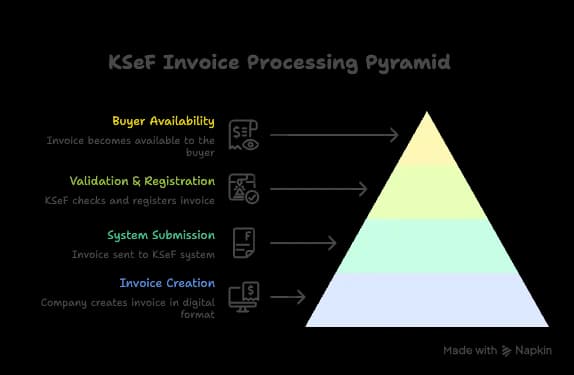
The basic flow is simple. A seller's accounting software builds an XML file in the FA(3) format, sends it to the KSeF API, and the system either accepts it (assigning a unique KSeF number and timestamp) or rejects it with a list of validation errors. Once an invoice is accepted, it is considered legally issued and delivered to the buyer at the moment of acceptance, regardless of whether the buyer has actually downloaded it. Both parties can access the invoice through the KSeF portal or through their own accounting software, which queries the same API.
KSeF replaces the loose collection of paper invoices, PDF attachments, and email forwards that used to dominate Polish B2B commerce. It is a fundamental change in how invoices work: there is no longer a private contract between two businesses about how to deliver an invoice. The Ministry of Finance is now part of every B2B transaction, with full visibility into invoice content within seconds of issue. This makes KSeF one of the most ambitious real-time e-invoicing systems in the world, comparable in scope to systems used in Italy, Hungary and Spain.
The mandatory rollout of KSeF is phased by company size, measured by the previous year's gross sales (including VAT). The phasing was introduced after a 2024 audit revealed that the system was not ready to absorb every Polish business at once. Instead, the largest taxpayers - who have the resources and existing IT teams to integrate quickly - went first, followed by everyone else, with the smallest businesses given the longest transition period.
The first phase began on February 1, 2026, when KSeF became mandatory for large taxpayers whose sales in 2024 exceeded 200 million PLN gross. This affects approximately 5,000 of the largest companies in Poland - corporations, banks, large retailers, manufacturers, and other organizations that already had the budget and motivation to roll out KSeF integration well in advance. For these businesses, the deadline was a planning milestone rather than a surprise.
The second phase, which is the one most readers of this guide care about, started on April 1, 2026. From this date, every VAT-registered business in Poland must issue B2B invoices through KSeF, regardless of size. This includes sole proprietors, small limited liability companies (sp. z o.o.), partnerships, freelancers on jednoosobowa działalność gospodarcza, and the entire Polish SME sector. There is no minimum turnover threshold for this phase: if you are registered for VAT, you are in.
The third and final phase begins on January 1, 2027 for micro-entrepreneurs whose monthly invoice values stay below 10,000 PLN gross. This deferral exists because the smallest businesses tend to have the fewest resources for IT changes and the lowest risk of mistakes harming the tax base. Even VAT-exempt businesses (those operating below the 200,000 PLN annual VAT threshold) eventually fall under the obligation through this phase.
| Date | Group | Threshold | Status |
|---|---|---|---|
| February 1, 2026 | Large taxpayers | 2024 gross sales above 200 million PLN | In effect (~5,000 companies) |
| April 1, 2026 | All other VAT-registered businesses | SMEs, sole proprietors, freelancers | In effect (vast majority of Polish firms) |
| January 1, 2027 | Micro-entrepreneurs | Monthly invoice value below 10,000 PLN gross | Upcoming (transition period) |
One important nuance: the 200 million PLN threshold for the first phase is based on 2024 sales only. Businesses that crossed the threshold for the first time in 2025 are not pulled into the first phase retroactively - they joined the second phase on April 1, 2026, like everyone else. Once a business is in KSeF, however, there is no going back. There is no provision for opting out, even if your sales drop below previous levels.
The short answer is: almost everyone. If you run a business in Poland and you issue invoices to other businesses, you are almost certainly within the scope of KSeF. The system was designed to capture the entire Polish B2B invoice flow, so the legislation casts a wide net and the exemptions are narrow.
Any business that is registered as a VAT payer in Poland - whether it is a sole proprietorship (jednoosobowa działalność gospodarcza), a limited liability company (sp. z o.o.), a joint stock company (S.A.) or a partnership - must issue B2B invoices through KSeF. The legal form does not matter, nor does the size of the business beyond the rollout phasing described above. If you are listed as an active VAT payer in the Polish white list (biała lista podatników VAT), KSeF applies to you.
Freelancers, consultants, contractors and other self-employed individuals operating on jednoosobowa działalność gospodarcza are treated the same as larger companies. From April 1, 2026, every JDG that is registered for VAT must issue invoices through KSeF for B2B transactions. This is the group that has felt the change most acutely: many sole proprietors had been issuing invoices using simple PDF templates or basic free tools, and the transition to KSeF has often required moving to a more capable accounting platform such as iFirma, inFakt, Fakturownia or wFirma.
Small businesses that benefit from the 200,000 PLN annual VAT exemption are not excluded from KSeF. They are simply pushed into the third rollout phase on January 1, 2027. This means that even one-person service businesses that issue a handful of invoices per year will eventually need to authenticate to KSeF and submit their invoices through the system, regardless of whether they collect VAT or not.
Foreign companies fall under KSeF only if they have a fixed establishment (FE) in Poland that is involved in supplying goods or services. Having a Polish VAT registration on its own does not trigger the obligation - what matters is whether you have physical or organizational presence in Poland that performs the relevant transactions. This distinction matters enormously for international groups, and we cover it in depth in the section on foreign companies below.
Not every document needs to flow through KSeF. The most important exclusions are B2C invoices issued to private consumers, simplified invoices known as paragon z NIP (cash register receipts up to 450 PLN issued with a NIP number), regular cash register receipts (paragony), and distance sales reported under the EU OSS or IOSS schemes. You can still issue these voluntarily through KSeF if it suits your workflow, but the law does not require it. Documents that are not invoices in the strict sense - such as proforma invoices, payment requests or internal cost notes - are also outside the scope of KSeF.
KSeF is fundamentally an API. Businesses do not log into a web form and type out invoices field by field, although that option exists in the free Ministry of Finance app. In the real world, almost every Polish business interacts with KSeF through their accounting software or ERP system, which sends structured XML files to the KSeF API in the background. The user issues an invoice the same way they always did - filling in client details, line items and amounts in their accounting tool - and the software handles the conversion and submission automatically.
Every invoice submitted to KSeF is validated against the FA(3) logical structure, which the Ministry of Finance published on June 25, 2025. FA(3) defines hundreds of mandatory and optional fields, the data types each field must use, the structure of nested elements, and the business rules that determine which combinations are valid. If any field is missing, malformed or inconsistent with the rest of the document, KSeF rejects the invoice and returns a list of errors. There is no "mostly correct" outcome - either the invoice is accepted as fully valid, or it is rejected and not legally issued.
When an invoice is accepted, KSeF assigns it a unique KSeF number and a timestamp. From that moment, the invoice is considered legally issued. The buyer's account in KSeF immediately shows the new invoice and they can download it, view it in their software, or process it for payment. There is no email exchange, no waiting for a PDF to arrive, and no risk that the invoice will be lost in a spam folder. Both seller and buyer can refer back to the same authoritative copy stored in the Ministry of Finance archive, which keeps invoices for 10 years free of charge.
Corrections work through dedicated correction invoices (faktura korygująca), which themselves go through KSeF and reference the original invoice by its KSeF number. This creates a complete, immutable audit trail of every change to every invoice, which is one of the main reasons the Ministry of Finance built the system in the first place: it makes VAT fraud and disputes substantially harder to execute.
Every transaction in KSeF is tied to the seller's and the buyer's NIP number, the Polish tax identification number. Both parties must have a valid, active NIP for an invoice to pass validation. This is a small but important detail for new businesses: before you can issue a single invoice through KSeF, your NIP needs to be registered and visible in the public databases.
Before you can issue or download invoices in KSeF, you need to authenticate yourself or your software. The Ministry of Finance supports four authentication methods, each suited to a different type of taxpayer. Choosing the right method is one of the more practical decisions you make when getting started with KSeF, because it affects how easily you can integrate accounting software, how you grant access to your accountant, and how secure your invoice flow is.
| Method | How it Works | Best for |
|---|---|---|
| KSeF Token | A long string generated in the KSeF portal and pasted into your accounting software. Software then talks to the API on your behalf. | Businesses using accounting software, ERP integration, automated invoicing |
| Qualified Electronic Signature | EU-compliant electronic signature issued by a certified provider. Used to authenticate as a specific person. | Companies, board members, accountants, lawyers |
| Trusted Profile (Profil Zaufany) | Free Polish government digital identity available to anyone with a PESEL number and a Polish bank account. | Sole proprietors, freelancers, micro-businesses |
| Qualified Electronic Seal | Electronic seal issued to organizations rather than individuals. Used for fully automated systems. | Large companies, automated invoicing pipelines |
For most sole proprietors, the easiest path is the trusted profile (Profil Zaufany). It costs nothing, you can set it up online if you have a Polish bank account, and it lets you log directly into the KSeF portal. The downside is that it ties authentication to a single person, so it does not scale well to teams or to automated software.
Companies typically use a combination of qualified electronic signatures (for board members, accountants and other named individuals) and KSeF tokens (for accounting software integration). The token model is particularly important because almost every modern Polish accounting platform expects to read and write invoices through the KSeF API on behalf of the user, which requires a token rather than a personal signature.
Permissions inside KSeF can be assigned at a granular level. The owner of a company can grant their accountant read-only access to incoming invoices, full access to issue invoices on the company's behalf, or limited access to specific document types. This permission model is one of the better-designed parts of the system and it lets businesses delegate KSeF tasks to external bookkeepers without handing over sensitive credentials.
Although KSeF is mandatory and adds an integration cost, the system does deliver real benefits once a business is set up. Most of these benefits become visible after the first few months of use, when the initial pain of integration is behind you and the new workflow becomes routine.
The most concrete financial benefit is a faster VAT refund. Invoices issued through KSeF qualify for a 40-day refund period instead of the standard 60 days. For businesses that regularly receive VAT refunds - exporters, capital-intensive companies, and any business in an investment phase - this is a real cash flow improvement worth tracking. Over the course of a year, a faster refund can free up tens or hundreds of thousands of zloty in working capital.
The second benefit is free 10-year archiving. Every invoice issued or received through KSeF is stored by the Ministry of Finance for ten years at no cost to the taxpayer. Businesses no longer need to maintain their own paper or PDF backups for tax purposes - the centralized archive is the official record. For accountants who used to spend significant time tracking down old invoices during audits, this is a major workflow improvement.
KSeF also eliminates the "lost invoice" dispute that has historically been a common source of friction between Polish businesses. Once an invoice is sent to KSeF and assigned a number, it cannot be lost, duplicated or disputed regarding receipt. Both seller and buyer see the same authoritative document at the same time, with the same timestamp. This is particularly valuable for businesses that work with slow payers or unreliable counterparties: there is no longer any plausible way for a buyer to claim they never received an invoice.
A more subtle benefit is the standardized format. The FA(3) XML schema ensures that every Polish B2B invoice has the same structure, the same fields, and the same validation rules. For accountants and ERP integrators, this means they no longer have to deal with hundreds of different invoice templates from different vendors. Every invoice can be imported and processed automatically, which dramatically reduces the manual data entry that used to dominate Polish bookkeeping.
Finally, KSeF reduces invoice fraud and tax evasion. Real-time submission to the tax authority makes it much harder to issue fake invoices, alter invoices after the fact, or hide transactions from KAS. This benefits honest businesses indirectly: a more transparent tax system means less tolerance for fraud, fewer audits triggered by anomalies, and a more level competitive field.
KSeF has been one of the most ambitious - and most controversial - tax IT projects in Poland. The original mandatory date was set for 2024, then postponed to mid-2024, then to 2026, after a critical audit revealed that the system was not technically ready to handle the full Polish invoice volume. Even in its current form, businesses, accountants, and industry associations have raised several recurring concerns that anyone preparing for KSeF should understand.
The mandatory date for KSeF moved several times over the past three years. Companies that invested in early integration during 2023, expecting a 2024 launch, ended up with software built against the older FA(2) schema that was later replaced by FA(3) in mid-2025. The Ministry of Finance's shifting timeline made it difficult for businesses and software vendors to plan investments, and many smaller companies postponed their preparations until the very last moment because they were not sure the deadline would actually hold.
The cost of getting onboarded to KSeF is real, especially for small businesses and sole proprietors. Most need to upgrade or replace their accounting software, buy a qualified electronic signature or set up a trusted profile, train staff on the new workflow, and in many cases pay an accountant to help with the migration. For a business that issues only a few invoices per month, the compliance cost can feel disproportionate to the volume. Larger companies absorb these costs through their existing IT budgets, but the smallest taxpayers often end up paying a relatively higher share of revenue on KSeF compliance.
The FA(3) XML schema has hundreds of fields and strict validation rules. Mistakes that previously caused a polite correction request from a buyer now result in an outright rejection from KSeF, with no invoice issued at all. Accountants in the early months of mandatory use have reported a significant increase in time spent fixing rejected invoices, particularly for non-standard transactions involving foreign currencies, mixed VAT rates, or industry-specific data. Most of these issues smooth out as accounting software matures, but the learning curve is steep.
During the voluntary phase between 2022 and 2025, KSeF experienced occasional outages. With millions of invoices flowing through the system after April 1, 2026, system capacity and uptime have become a constant concern. The Ministry of Finance introduced a dedicated offline mode specifically to handle outages: if KSeF is down, you can issue an invoice marked as offline and submit it to KSeF on the next business day. This is a sensible safety valve, but it adds complexity and forces businesses to monitor system status as part of their daily routine.
Businesses with complex billing arrangements - long technical attachments, multi-currency invoices, special VAT schemes, industry-specific documents, or invoices with negotiated free-text terms - have reported friction in adapting their workflows to the rigid XML structure. KSeF supports attachments and additional metadata, but the format is much less flexible than a free-form PDF. Some companies have had to redesign their billing processes around what KSeF allows rather than what their customers prefer.
All B2B invoice data is stored on government servers for ten years. While this is technically convenient, some businesses (especially those with sensitive commercial relationships, such as legal services, M&A advisory, or technology vendors with confidential client lists) are uncomfortable with that level of centralization. The Ministry of Finance has strict rules on access, but the structural fact that every Polish invoice is now visible to the tax administration in real time is a significant change from the historical norm.
Foreign companies with a fixed establishment in Poland must comply just like domestic ones, which often means setting up Polish authentication credentials, working with a local accountant, and integrating their global ERP system with a Polish-only e-invoicing platform. For multinationals that already operate complex e-invoicing workflows for Italy, Hungary, Spain, and other markets, KSeF is yet another national system to bolt on. Some have responded by treating their Polish operations as a separate process rather than trying to integrate KSeF into their global invoice flow.
None of these issues stop KSeF from being mandatory - the obligation applies regardless of how prepared a business is. The practical takeaway is that the earlier you integrate with a reliable accounting platform and test the full invoice flow, the fewer surprises you will face when an important customer or supplier expects everything to work on day one.
The shift to KSeF changes more than just the technical format of invoices - it changes the legal status of an invoice, the moment at which it is considered delivered, and the way both parties archive their records. The table below summarizes the most important differences between a KSeF e-invoice and a traditional paper or PDF invoice in Poland.
| Feature | KSeF E-Invoice | Paper / PDF Invoice |
|---|---|---|
| Format | Structured XML (FA(3) schema) | Paper or PDF, free format |
| Delivery | Automatic via KSeF system | Email, post, in-person |
| Issue date | Date sent to KSeF | Date on the document |
| Receipt confirmation | Automatic, with timestamp | Manual confirmation |
| Archiving | 10 years, free, by Ministry of Finance | 5 years, by taxpayer |
| VAT refund period | 40 days | 60 days |
| Risk of loss | None - centralized storage | Possible (lost emails, files) |
| Validation | Real-time, against FA(3) schema | Manual, after the fact |
| Visibility to tax authority | Immediate | Only via JPK_VAT or audit |
| Mandatory since | April 1, 2026 for all VAT payers | No longer permitted for B2B |
Polish taxes can be confusing for foreigners. Get matched with an accountant who speaks English and knows the rules for expats.
Tax filing support
PIT, CIT, VAT returns handled correctly - avoid penalties and overpayment
Fluent in English
No language barrier - discuss your finances clearly and get advice you understand
Expat tax expertise
Double taxation treaties, foreign income, ZUS obligations - they know the specifics
Free matching
No cost to you - we connect you with the right accountant for your situation
Getting onboarded to KSeF is straightforward, especially if you already use accounting software. Most Polish bookkeeping platforms have built KSeF integration into their core product over the past two years, and the user-facing experience is now close to invisible: you issue an invoice the same way you always did, and the software submits it to KSeF in the background.
The harder steps are usually administrative - making sure your NIP and VAT registration are clean, choosing the right authentication method, integrating your accounting software with the KSeF API, and informing your trading partners about the change. The six steps below walk through the full onboarding process from a standing start.
Before you do anything else, make sure your NIP number is active and that your business is correctly registered as a VAT payer in CEIDG (for sole proprietors) or KRS (for companies). KSeF identifies all parties by NIP, and any inconsistency in your registration data will block invoice acceptance. Check that your NIP appears in the Polish white list (biała lista podatników VAT) and that your registered address and bank account information match what is in the tax office records.
For sole proprietors, the easiest option is the free trusted profile (Profil Zaufany), which you can set up online if you have a PESEL number and a Polish bank account. Companies usually need a qualified electronic signature for the people who will manage invoices - typically the board members, the chief accountant, or an external bookkeeper. If you plan to integrate KSeF with accounting software, you will also need to generate at least one KSeF token in the portal after authenticating with one of the personal methods.
Almost every Polish accounting platform now supports KSeF natively. The most popular options for small and mid-sized businesses are iFirma, Comarch, inFakt, Fakturownia and wFirma. Larger companies often use SAP, Microsoft Dynamics, Comarch ERP XL, or other ERP systems that have built KSeF connectors. If you do not use any accounting software, the Ministry of Finance offers a free official KSeF web app that lets you issue and download invoices directly in a browser - useful for very small businesses with low invoice volume, though it is not practical at scale.
Online businesses that take payments through Stripe face an extra step: every Stripe transaction needs to be turned into a KSeF-compliant VAT invoice. Stripto.pl bridges Stripe with KSeF via Fakturownia, inFakt or wFirma, so every payment becomes an automatic VAT invoice issued through your accounting platform and sent to KSeF. It costs 29 PLN per month and the setup takes around 60 seconds, which is a useful shortcut if you do not want to write your own integration. SaaS businesses, e-commerce stores and digital service providers are the main audience for this kind of bridge.
Once you are authenticated in the KSeF portal, generate the API tokens that your accounting software will use, and assign roles to the people in your company who need access. KSeF supports granular permissions: you can give your accountant read access to incoming invoices, your sales team the ability to issue invoices, and your management board full control. Take the time to set up roles correctly - it is much easier to do this now than to fix it later when an audit reveals that someone had more access than they needed.
Before going live, send at least one test invoice through your software's KSeF integration. Confirm that the invoice receives a valid KSeF number, that the timestamp matches your expectations, and that the buyer can see it in their own KSeF account. Many integration bugs only show up the first time you actually push an invoice to the production API, so it is much better to find them in a controlled test than in front of an important customer.
Let your regular B2B counterparties know that future invoices will arrive via KSeF and will no longer be sent by email. Most Polish businesses are already aware of the change, but a short notice helps avoid confusion - especially with smaller suppliers or international clients who may not be following Polish tax news. Many businesses still attach a courtesy PDF copy by email during the first months of the rollout, which is fine and not legally problematic. Just remember that the legal invoice is the one in KSeF, not the PDF.
Once KSeF is mandatory for your business, failing to issue invoices through the system - or issuing them outside KSeF when you were supposed to use it - can trigger financial penalties. The Polish tax authority (KAS) has been using a soft approach in the first months of the rollout, focusing on guidance and education rather than fines, but the legal framework is already in place and KAS can apply it at any time.
The penalty structure has two main rates. For standard VAT invoices, the maximum penalty is up to 100 percent of the VAT amount shown on an invoice that should have been issued through KSeF but was not. For invoices issued by VAT-exempt sellers (where there is no VAT amount), the maximum penalty is up to 18.7 percent of the gross invoice value. These are upper limits, not automatic charges, and KAS uses discretion when deciding whether and how to apply them.
| Invoice Type | Maximum Penalty | Calculated On |
|---|---|---|
| Standard VAT invoice | Up to 100% of VAT | VAT amount on the missed invoice |
| VAT-exempt invoice | Up to 18.7% of gross value | Total invoice amount |
Penalties are not automatic. KAS evaluates each case individually, and minor or first-time mistakes are typically met with warnings rather than fines. Repeated non-compliance, deliberate avoidance, or attempts to issue invoices outside KSeF as a way to hide transactions from KAS are far more likely to attract real penalties. The most reliable way to stay compliant is to make sure your accounting software is correctly integrated with KSeF, that your team understands when an invoice must be issued through the system, and that you respond quickly to any rejection messages from the KSeF API.
It is worth noting that the offline mode protects you in genuine emergencies. If KSeF is down on the day you need to issue an invoice, you can mark the invoice as offline, deliver it to the buyer in any reasonable way, and send it to KSeF on the next business day. This is not a way to opt out - it is a safety valve for outages. Misusing offline mode for normal invoices can itself be treated as non-compliance.
KSeF treats foreign companies very differently depending on whether they have a fixed establishment (FE) in Poland. The distinction is more important than it sounds, and getting it wrong is one of the most common mistakes that international groups make when assessing their Polish obligations. The general rule is that Polish VAT registration alone does not pull a foreign business into KSeF - what matters is whether the business has a physical or organizational presence in Poland that participates in the relevant transactions.
If your business is registered for Polish VAT but does not have a fixed establishment in Poland - for example, if you sell goods to Polish customers from a warehouse in Germany, or you provide digital services to Polish businesses from an office in another EU country - you are notrequired to issue invoices through KSeF. You can continue to issue invoices in your usual format under your home country's rules, with Polish VAT correctly accounted for. However, your Polish counterparties may still send invoices to you through KSeF, and you should arrange a way to access them, either through the KSeF portal or through an accounting service that connects to KSeF on your behalf.
If your business has a Polish branch, office, subsidiary or any other fixed establishment that participates in supplying goods or services in Poland, the situation is the opposite: you must issue KSeF invoices for those transactions, exactly like a Polish company. Practically, this means obtaining a Polish NIP, choosing one of the four authentication methods, integrating KSeF with your global ERP system or working with a local accountant, and running invoices for Polish operations through the KSeF flow even if your global accounting is centralized abroad.
The definition of "fixed establishment" under Polish VAT law is not always intuitive. Having a single employee in Poland may or may not constitute an FE depending on what they do. A leased warehouse with no staff is generally not an FE, while a fully staffed office almost always is. Some constellations - such as having a sales agent in Poland who can conclude contracts on your behalf - fall into a grey area where the answer depends on detailed facts. If you are unsure whether your Polish operations meet the FE definition, it is worth getting a written opinion from a Polish tax advisor before assuming you are exempt from KSeF.
Multinational groups that operate in several EU countries are increasingly treating KSeF as one of several national e-invoicing systems they need to support, alongside Italy's SDI, Hungary's NAV Online Invoice, Spain's SII and several others that are coming. The most common architecture is to keep core invoicing in the global ERP system and add a national connector for each country, rather than trying to build a single global e-invoicing engine. KSeF fits this pattern, and most large ERP vendors now offer either a native KSeF connector or a tested integration with a Polish middleware provider.
If you are unsure how KSeF applies to your specific cross-border operations, an experienced Polish accountant or tax advisor can save you a great deal of time. We can help match you with one through our accountant lead form above.
KSeF (Krajowy System e-Faktur) is Poland's National e-Invoicing System, operated by the Ministry of Finance. It is a centralized IT platform for issuing, receiving and storing structured electronic invoices in a standardized XML format. As of April 1, 2026, KSeF is mandatory for all VAT-registered businesses in Poland for B2B transactions.
KSeF became mandatory on February 1, 2026 for large taxpayers with 2024 sales above 200 million PLN, and on April 1, 2026 for all other VAT-registered businesses. Micro-entrepreneurs with monthly invoice values below 10,000 PLN gross get an additional grace period until January 1, 2027.
No. Invoices issued to private consumers (B2C) are excluded from the mandatory KSeF system. You can still issue B2C invoices voluntarily through KSeF, but it is not required. Receipts from cash registers (paragony) are also not subject to KSeF.
Foreign companies need to use KSeF only if they have a fixed establishment (FE) in Poland that participates in the relevant supply of goods or services. Foreign businesses registered for Polish VAT without a fixed establishment are exempt from the obligation to issue invoices through KSeF, although their Polish counterparties may still send invoices to them through KSeF.
Non-compliance with KSeF can result in penalties of up to 100% of the VAT amount on the invoice, or up to 18.7% of the gross invoice value for VAT-exempt invoices. The Polish tax authority (KAS) has discretion in applying penalties, and the first months after the rollout are typically used for guidance rather than fines.
FA(3) is the current logical structure of the Polish e-invoice, published by the Ministry of Finance on June 25, 2025. It defines all the fields, formats and rules an XML invoice must follow to be accepted by KSeF. It replaces the earlier FA(2) schema and includes additional fields for attachments, payment data and corrections.
Yes. KSeF includes an offline mode for emergency situations. If the system is unavailable, you can issue an invoice marked as offline and send it to KSeF within the next business day after the outage ends. The invoice is still legally valid from the moment of issue.
There are four authentication methods: a KSeF token (most common for software integration), a qualified electronic signature, a trusted profile (Profil Zaufany), or a qualified electronic seal. Sole proprietors most often use a trusted profile, while companies typically use tokens or qualified signatures.
No. Once an invoice is registered in KSeF, the buyer is considered to have received it automatically. You do not need to send a PDF or paper copy. However, many businesses still send a courtesy copy by email for convenience, especially during the transition period.
Not entirely. KSeF handles the issuing and receiving of invoices, while JPK_VAT (the standard audit file for VAT) still needs to be submitted monthly. However, because KSeF already contains your structured invoice data, the JPK process becomes simpler and most accounting software prefills it automatically.
Invoices issued through KSeF qualify for a faster VAT refund period of 40 days instead of the standard 60 days. This is one of the few direct financial incentives built into the system and improves cash flow for businesses that regularly receive VAT refunds.
All invoices issued through KSeF are stored by the Ministry of Finance for 10 years free of charge. You do not need to keep your own paper or PDF backups for tax purposes - the centralized archive is the official record.